
The stealth job search: how to look while you're still employed
Looking for a job while employed can give you time to be selective, but no privacy setting makes the search invisible. Keep it off work systems, limit what you broadcast and plan for the possibility that someone notices.
Searching while employed may give you more financial room to wait for a suitable role, although that depends on why you are leaving and how secure the current job feels. The awkward part is that a profile update, colleague or misplaced file can reveal the search before you are ready to discuss it.
So the whole game is discretion. Most of the leaks are avoidable once you know where they come from. Here's the playbook.
The discretion checklist
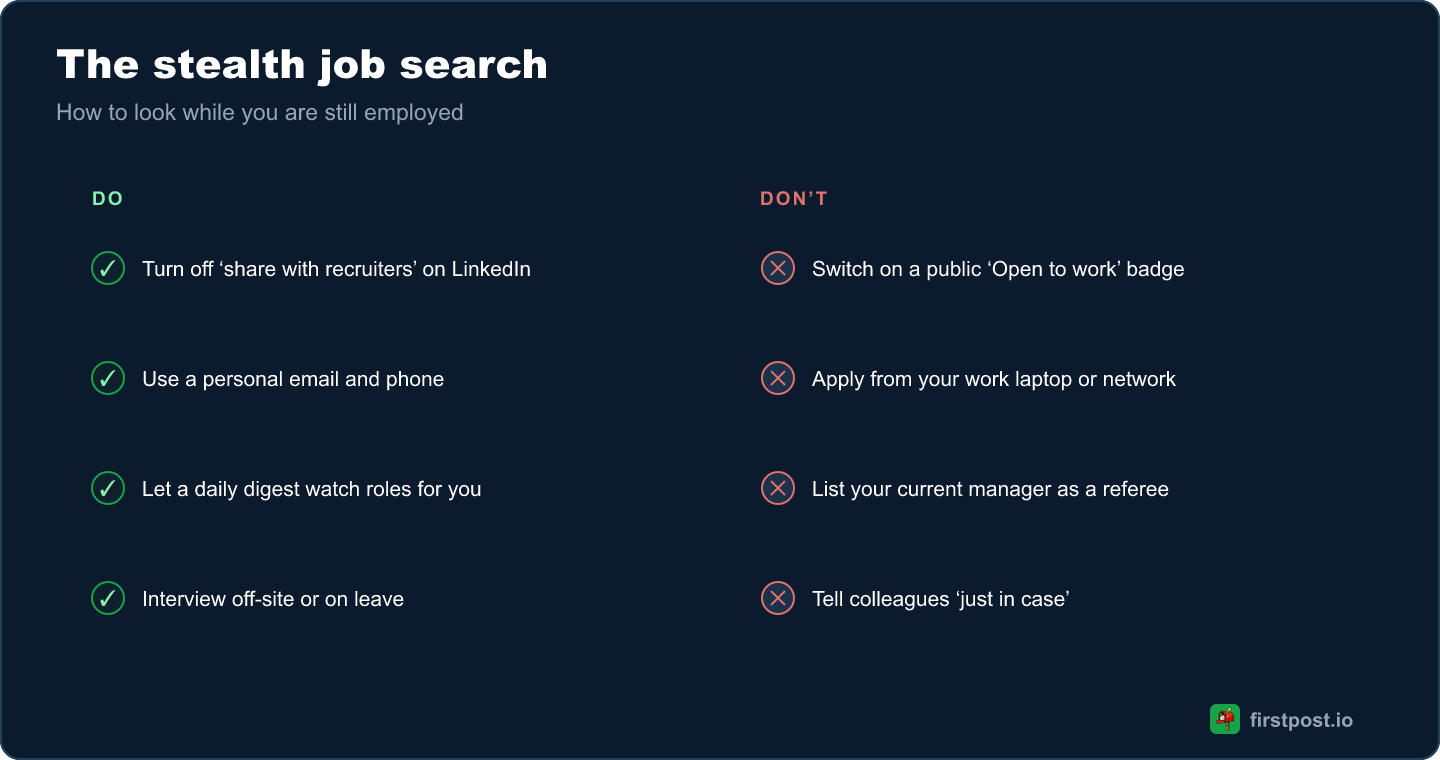
Lock down LinkedIn first
LinkedIn can reveal activity through profile changes, network interactions and visibility settings. Three checks matter most:
- Turn off activity broadcasts. If updating your profile fires a notification to your whole network - including colleagues - a flurry of edits is a giant flashing sign. Switch this off before you touch anything.
- Choose the "Open to work" audience deliberately. The public badge is visible to your network, while the recruiter setting is quieter but not a promise of secrecy. If disclosure would create a serious risk, leaving both off may be the safer choice.
- Check "let recruiters know you're open" carefully. It tries to hide your signal from people at your own company, but it's an imperfect filter. Treat it as helpful, not foolproof.
Then resist the urge to suddenly overhaul your whole profile. A dormant profile that springs to life with a new headline, a fresh photo and ten new connections in your target industry is conspicuous. Make changes gradually, with broadcasts off.
Keep it off your employer's systems entirely
Treat work devices, accounts and networks as employer systems, subject to the policies and monitoring that apply where you work. That means:
- Never apply, job-search or email recruiters from a work device or the office network.
- Use a personal email address and phone number on every application - not your work ones, and not an address that obviously belongs to your current company.
- Don't store CVs, cover letters or interview notes in a work account or company cloud drive.
Do all of it on your own devices, on your own time. It sounds obvious written down; it's astonishing how often a search unravels because someone fired off an application on their lunch break from the work laptop.
Handle references and interviews with care
Two classic traps:
- References. Never offer your current manager as a referee during the process - it forces a disclosure you're not ready for. Use former managers, colleagues who've left, or clients. A reasonable employer understands completely if you say "I'd prefer not to involve my current employer until we're at offer stage." Any employer that won't accept that is telling you something.
- Interviews. Schedule them outside work hours where you can, or use annual leave - a "dentist appointment" that recurs weekly is not subtle. Take video interviews from home, never from a meeting room your colleagues can see into or book over.
Let the search run quietly in the background
The biggest practical challenge of a stealth search isn't any single setting - it's that you have little time and can't be seen trawling job boards at your desk. This is exactly where a passive, low-profile approach earns its keep. Rather than actively browsing, let new roles come to you: set your criteria once and have matching roles arrive in a single daily email you read at home, on your own device, in five quiet minutes.
A digest keeps routine checking away from the workday, provided it goes to your personal account and device. If you would consider more than one kind of move, you can run separate searches in parallel rather than broadening one alert until it becomes noise. That is the model FirstPost is built around. Starter is free.
No method is foolproof
No search is perfectly invisible, so plan what you would say if it surfaced. Keep the search on your own devices and accounts, follow the policies and contractual duties that apply to you, and do not share confidential information in an application. That reduces avoidable risk without pretending that a platform setting or careful routine can remove it entirely.