
Seasonal hiring: should you pause your job search?
Hiring does not stop everywhere in August or December, but it does not follow one tidy calendar either. Your sector, location and target employers matter more than a universal "busy" or "dead" month.
Advice to stop searching over summer or the winter holidays is too broad to be useful. Some teams pause decisions while people are away, some sectors work to seasonal cycles and other employers keep recruiting because the vacancy still needs filling.
The reason the belief is so sticky is that it confuses two different things: how many roles are being posted, and how quickly applications are being processed. Those move very differently across the year.
What the months actually look like
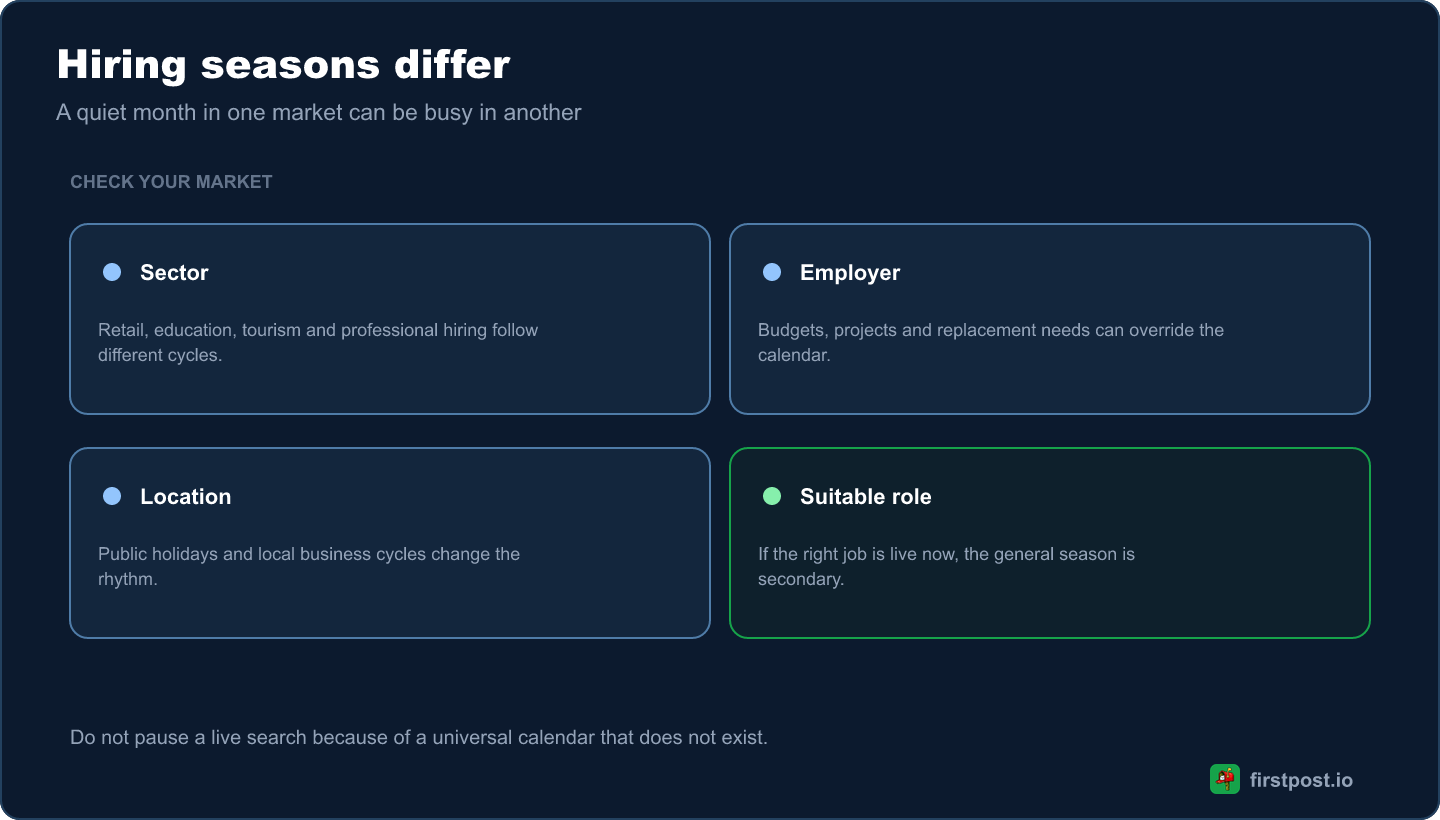
A chart cannot settle this for every job seeker. Retail, education, tourism, graduate schemes and corporate budgeting can each create different peaks and pauses. Use broad seasonality as context, then look at current vacancies in your own market before deciding that nothing is moving.
So if the roles are still being posted, where does the powerful feeling of a slowdown come from? From the other side of the desk.
The dip is in decisions, not postings
During holiday periods, recruiter or hiring-manager leave can slow replies even when adverts remain open. In other cases, the employer may delay approval or pause the vacancy entirely. Silence alone does not tell you which is happening.
The practical decision is local. If suitable roles are live in your sector and location, a broad claim about a quiet season is not a reason to ignore them. Apply while the vacancy is current; if the market is genuinely sparse, use the quieter period to refine the target list and evidence.
Why the quiet periods can actually favour you
Continuing through a quieter period can still be useful because suitable roles do appear and you keep your routine intact. Do not assume competition has fallen, though; applicant volume is not visible for most vacancies and can move differently from posting volume.
So the contrarian move pays off twice over:
- Fewer competitors. The candidates who bought the myth aren't applying, so your application stands out in a smaller pile.
- Pole position when things restart. Apply in late August or mid-December and your CV is near the top of an inbox that gets cleared the moment the decision-maker returns, rested and keen to fill the role.
- Momentum into the busy season. Hiring ramps hard in September and January. Being already in-process when that happens beats starting from scratch alongside everyone else.
If you plan to restart in January, you can still prepare target employers, alerts and reusable application material before then. The calendar matters, but it does not turn a suitable role into an unsuitable one or repair a rushed application.
The grain of truth
Your field may have a rhythm worth respecting. Retail, education, tourism and graduate recruitment do not move on the same calendar, and individual employers can pause hiring for reasons you cannot see. Keep watching for suitable roles unless you have a deliberate reason to stop, expect replies to take longer around holidays, and use a manageable application routine rather than trying to manufacture urgency. FirstPost can keep your saved searches running while you take a break from manual checking. Try FirstPost free.