
The most in-demand skills right now, by industry
A dated list of fashionable skills won't tell you what employers in your field are asking for now. This article uses a live snapshot of advertised roles instead. It is useful for spotting current language and direction, provided you don't mistake a snapshot for a forecast.
A generic list of "the 10 most in-demand skills" can mix useful observations with claims that are undated or too broad for your field. A current snapshot answers a smaller question: which words and titles recur in the vacancies being measured now?
So let's try the opposite. Instead of a forecast, a snapshot - drawn from the roles companies have live on their careers pages and on public job boards right now, across more than 40 industries. The point isn't to predict the future. It's to tell you, with reasonable candour, what is being hired for today, in language specific enough that you can act on it this week.
This is a live snapshot, not a survey or a forecast. We read the titles and descriptions of currently open roles and surface the titles gaining momentum over the past seven days, alongside the words that recur most often in each industry's postings. It's a picture of demand as employers themselves have phrased it. Two things worth keeping in mind: a snapshot shifts week to week, and a "fast-rising" title on a small base can move more dramatically than a steady giant. Read momentum and volume as two different signals, which is exactly what the next section is about.
A worked example: Tech / IT
Tech is the easiest industry to start with because the titles are granular and the movement is fast. Here's the live view of which Tech / IT titles are gaining the most ground week-on-week.
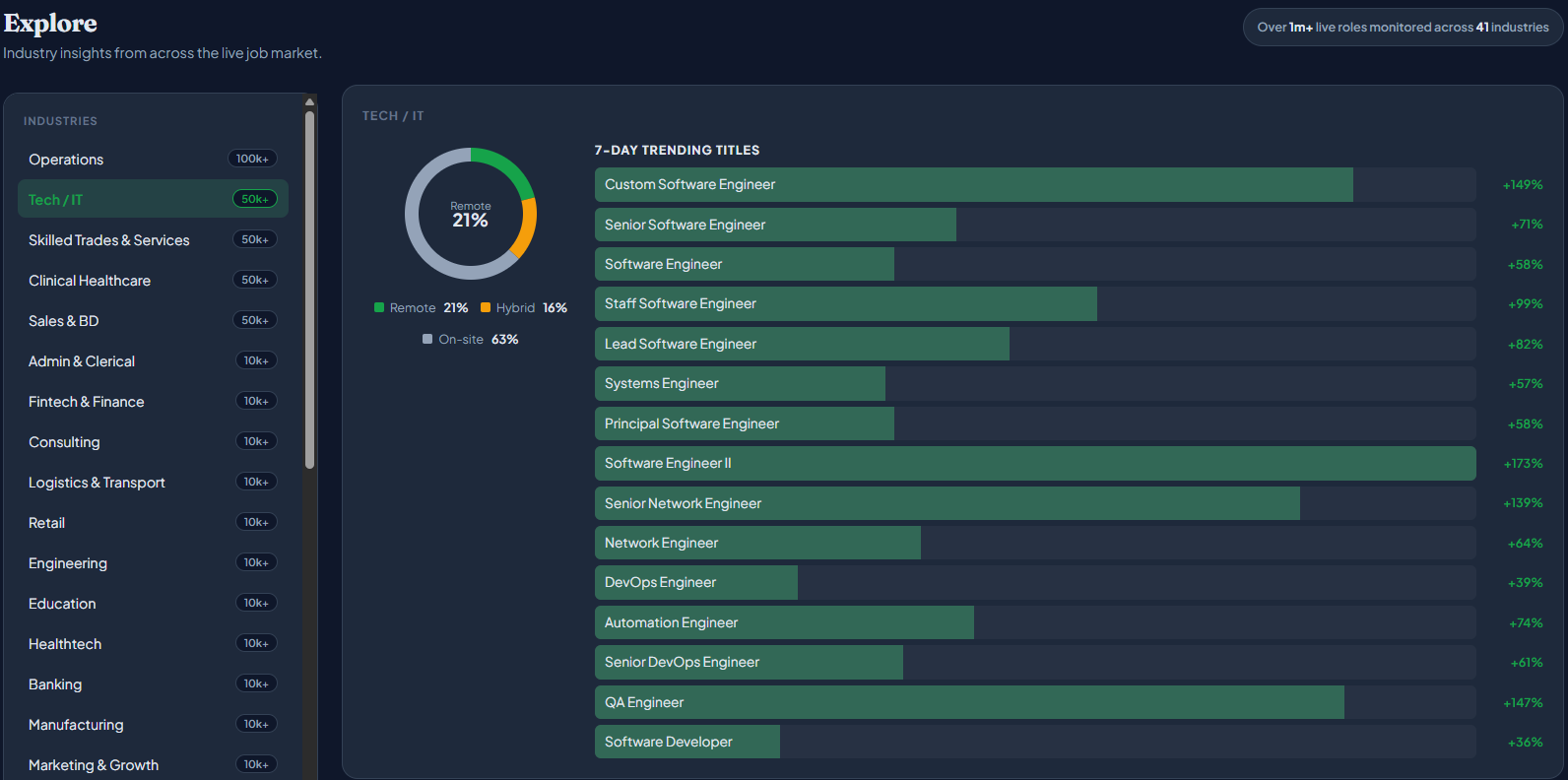
Two features of this snapshot are worth separating. Senior, staff, principal and lead engineering titles appear among the climbers, but title movement alone cannot tell us whether teams are deepening or simply replacing people. Network, systems, DevOps, automation and quality roles also feature, showing advertised demand beyond product-feature work in this sample.
The work-arrangement split is its own data point. In this snapshot, roughly one in five Tech / IT roles is flagged remote and about one in six hybrid, with the majority still on-site or unspecified. Useful if you're filtering hard on remote - it's available, but it's the minority, so a remote-only search in this field is a much narrower search than people assume.
Now the skills. If you strip the titles down to the words that recur across the descriptions, you get a rough map of what the field is actually asking for.

The biggest words are no surprise - software, systems, cloud, data - but the mid-tier is where the useful signal sits: automation, reliability, security, integration, infrastructure. These are the words that distinguish a candidate who can build from one who can build and operate at scale, and they're the ones worth making sure your CV actually contains if they describe your work.
The same view, 40-odd other industries
The Tech / IT picture is vivid, but it's not representative - most of the job market isn't software. Run the same lens across other industries and the texture changes completely:
- In clinical healthcare and skilled trades, the recurring words are about certification, safety and specific procedures, not tools. Demand is concrete and credential-gated.
- In sales and business development, the language clusters around pipeline, accounts, territory and quota - and the trending titles move with the economy more visibly than almost any other field.
- In operations and logistics, the recurring skills are scheduling, coordination, forecasting and compliance: the unglamorous operational backbone that every company needs and few articles celebrate.
Looking across the industries also reveals useful overlap. Working with the people involved, data literacy, process improvement, customer handling and basic automation recur across several lists. If you're considering a move, that overlap gives you a more honest starting point than pretending none of your existing work transfers. We pull that thread properly in our guide to changing careers without starting from scratch.
How to actually use this
Demand data is interesting; demand data that changes your behaviour is valuable. Three concrete moves:
- Match your search titles to the live ones. Job titles are not standardised, and the difference between "Software Engineer" and "Systems Engineer" in your saved search is the difference between seeing a role and missing it. Look at which titles are actually trending in your field and make sure your searches include the real ones, not just the one on your last contract.
- Put the recurring words on your CV - if they're true. Not keyword-stuffing. If your work genuinely involves the skills that keep appearing in your target postings, name them in the same plain language the postings use. Recruiters and the software they screen with both scan for the words they wrote.
- Treat momentum as a tailwind, not a target. A fast-rising title tells you where hiring is opening up, which is where applying early pays off most. It does not tell you to abandon a stable, high-volume field for a trendy one. Volume is where the jobs are; momentum is where the new jobs are. You want both in view.
This live, by-industry view - top titles, top employers, top locations, seven-day trending roles and in-demand skills - is what the Explore feature on FirstPost is for. It's included with Pro, and it updates as the market does, so it's a current picture rather than a January listicle. Better still, when you spot a title trending up, you can add it straight to one of your saved searches, so matching roles start arriving in your daily digest from the next morning. You can see it after signing up.
How to read this, and how not to
This snapshot tells you what is being advertised, not how easy any role is to win. A skill can be in high demand and high supply at the same time, while employer wording is noisy and sometimes aspirational. Use the data to improve your search terms and decide what to investigate, then judge each opening on fit. Seeing the right role early still helps, which is where the early-applicant routine comes in.