
How to change careers without starting from scratch
Changing fields doesn't always mean returning to entry level. The useful question is which parts of your experience the new field will pay for, which parts need translating, and where a qualification genuinely forces you to start again.
People sometimes stay in a job they have outgrown because they assume a change means starting again at the bottom. That may be true for a regulated profession, but many moves depend on translating existing evidence into a role that values it.
Most career changes are not a reset to zero. They're a relabelling. The work you've actually been doing - leading people, hitting numbers, untangling messes, keeping demanding customers happy - is in demand in dozens of fields under dozens of different titles. The change isn't learning everything again. It's recognising which of your existing skills travel, finding where they're wanted, and describing them in the new field's language.
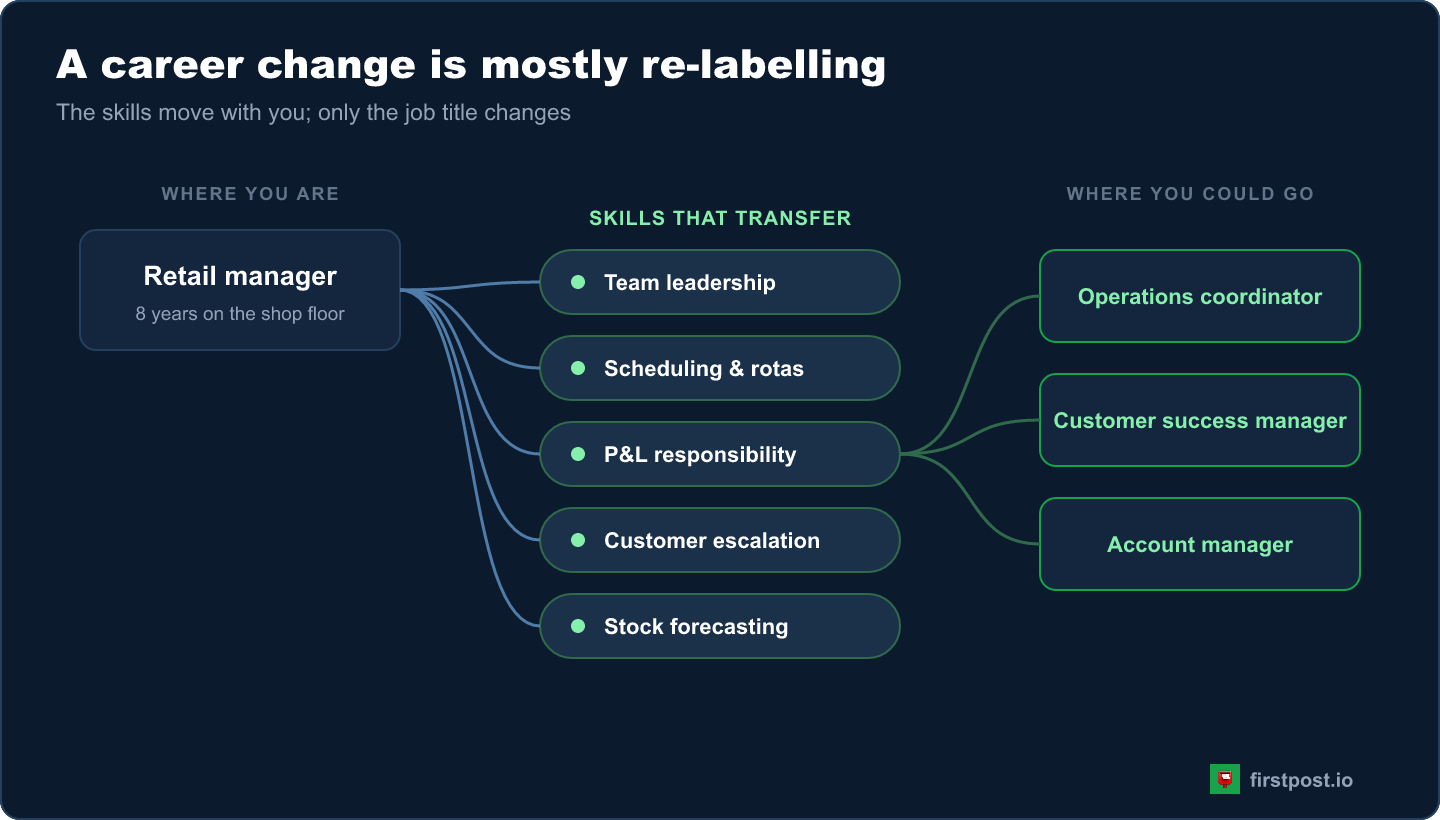
The retail manager in that diagram isn't qualified for "nothing else". They have profit-and-loss responsibility, team leadership, forecasting and a decade of defusing angry customers. Those are precisely the skills an operations coordinator, a customer success manager or an account manager is hired for. The hard part was never the capability. It's knowing the bridge exists and how to walk across it.
Step 1: inventory what actually transfers
Start by separating your experience into two buckets: the field-specific and the portable. Field-specific is the stuff that only counts in your current industry - a particular regulation, a niche tool, a sector relationship. Portable is everything that would matter anywhere:
- Leading, hiring and developing people
- Owning a budget, a target or a P&L line
- Managing projects, deadlines and competing priorities
- Handling customers, clients or stakeholders - especially difficult ones
- Working with data to make a decision
- Communicating clearly in writing and in the room
Write yours down as concrete evidence, not adjectives. Not “good leader” but “ran a team of nine through a restructure with no resignations”. You may find more portable evidence than the old job title suggests, and that is the raw material for the move.
Step 2: find where those skills are wanted
This is the step people skip, and it's the one that turns a vague itch into a plan. Before you commit to a direction, look at what's actually being hired for and which fields value the skills you just listed. You're looking for the overlap between "what I can already do" and "what's in demand".
A live view of the market helps here because portable skills can appear across quite different industries. Our look at the most in-demand skills by industry shows overlap in working with the people involved, data literacy, customer handling and process improvement. The Explore feature on FirstPost lets you browse titles and recurring skills by industry, which can help you find fields where your existing strengths are central rather than incidental. It's worth a look before you fix on a direction.
Step 3: aim for the bridge role, not the dream
The most common mistake in a career change is aiming straight at the end state - the senior role in the new field that would take five years and a requalification to reach directly. Aim for the bridge instead: the adjacent role that values what you already have and gets you inside the new field, where the next move is internal and far easier.
A teacher doesn't have to leap to "head of learning design at a tech company". They can move to a training or onboarding role first, where classroom skills are the obvious qualification, and pivot from there. A retail manager doesn't jump to "VP of operations". They take the operations coordinator role and climb inside ops. The bridge role feels less glamorous, but it's the move that actually happens, because the hiring manager can see exactly why you fit.
Step 4: test the pivot without quitting
You do not have to resign to test whether a pivot is realistic. Run a quiet parallel search while you keep your current job. Live adverts show which titles and requirements employers are using now; salary information and application results add evidence, though neither gives a complete market picture.
This is exactly what running more than one saved search is for. Keep your core, current-field search live, and add a second, exploratory one pointed at the bridge roles you identified. Our guide to tracking multiple job searches at once walks through setting this up so the two don't blur together. The pivot search becomes a low-stakes experiment: if the right roles keep appearing and you start getting responses, the move is real; if they don't, you've learned that cheaply, without burning a bridge.
Step 5: apply early, and tell the transferable story
When a suitable bridge role appears, timing and translation work together. Reaching the employer source before the queue and shortlist build gives your unconventional evidence a real visibility advantage; the application still has to explain why the old work transfers. Our guide to applying early covers a routine that preserves both.
The second is translation. Rewrite your experience in the target field's vocabulary - the same plain words their postings and the software they screen with use. "Managed stock across a £4m store" becomes, for an operations role, "owned inventory planning and forecasting for a multi-million-pound P&L". Same fact, read in the new field's language. You're not inventing anything; you're making the bridge legible to someone who doesn't know your old industry.
A worked example: leaving the military
A move from military service into civilian work makes the translation problem particularly visible: strong evidence can be expressed in terms a civilian recruiter does not immediately recognise. We wrote a dedicated guide on translating military experience into civilian job titles employers recognise. The same structure applies here: inventory the portable skills, find roles that value them and describe the evidence in language the hiring side understands.
Where it gets harder
Not every change is a relabelling, and pretending otherwise would be dishonest. Some fields are genuinely gated by qualification - you cannot bridge your way into practising medicine, law or a regulated trade without the training and the licence, full stop. For those, the "without starting from scratch" framing partly breaks, and you should go in clear-eyed about the time and cost. And even for the bridgeable moves, expect a pivot search to take longer and more applications than a like-for-like one; you're asking hiring managers to make a small leap, and not all of them will. Budget for that. But for the broad middle of career changes - the ones held back by belief rather than by a licensing board - you are far less stuck than you think. The skills are already yours. The rest is finding where they're wanted and getting there early.