
How many applications does it take to get a job?
There is no reliable application count that ends in a job. Your market, fit, timing and selection process all change the funnel, so the useful question is where your own applications stop converting and what you can improve there.
When the search is going badly, people reach for a number. "I've sent ninety applications." It's a way of measuring effort when nothing else gives feedback. The trouble is that the raw count is almost meaningless on its own, and fixating on it usually makes the search worse, not better.
Let's put a realistic shape on it, then explain why the number you should care about isn't the one you've been counting.
Read the funnel by stage
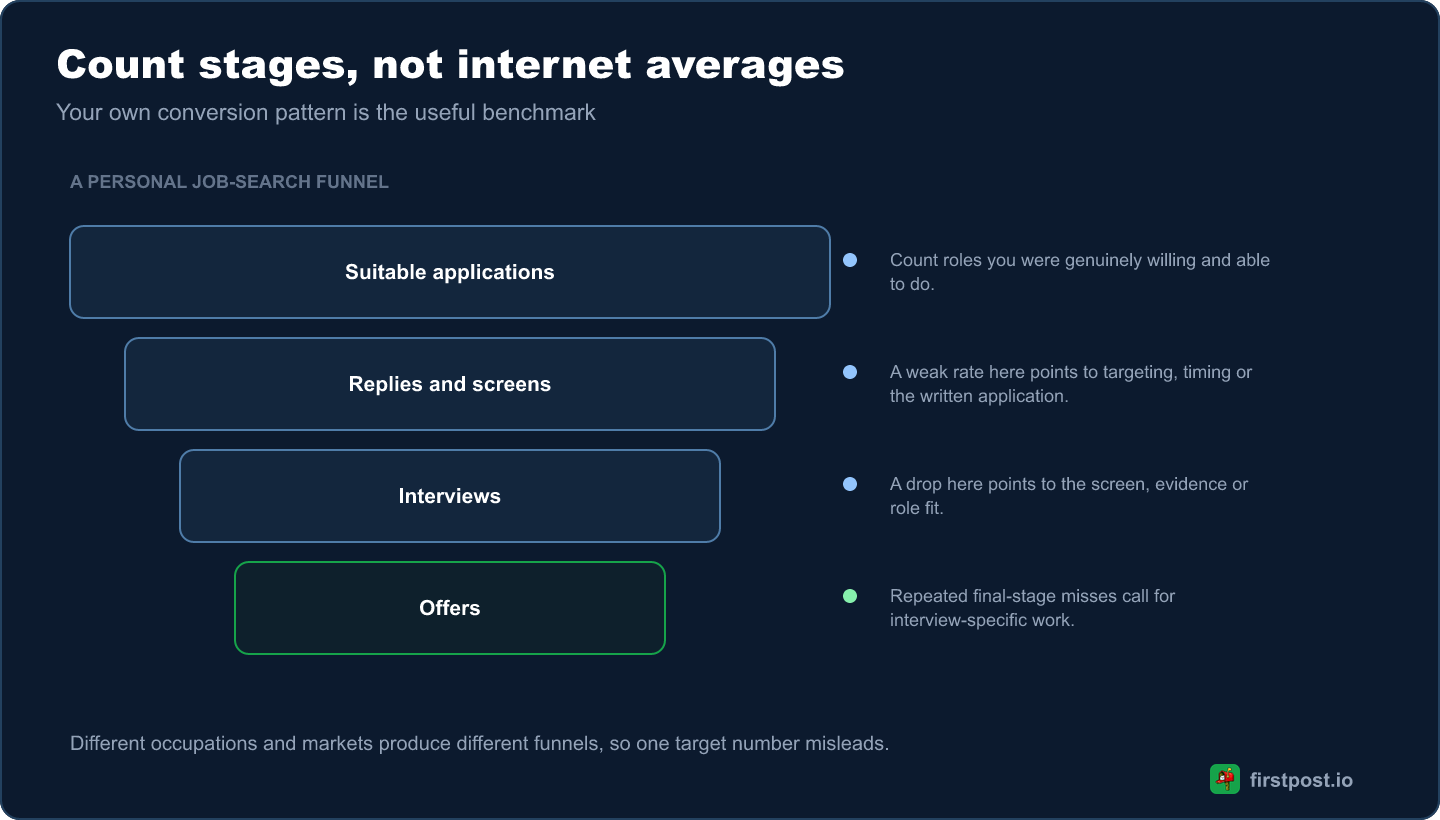
The funnel runs from suitable applications to screens, interviews, later stages and, eventually, an offer. No defensible set of conversion numbers applies across occupations and markets. Use the stages to diagnose your own search: no screens points to a different problem from plenty of interviews with no offer.
And the variation is the important part, so read these as orientation, not as targets. The funnel shifts dramatically with:
- Seniority. Senior and specialist searches may have fewer suitable openings, while each application takes more judgement. That makes a raw weekly target especially unhelpful.
- Field. A nurse, a primary teacher and a games designer are searching three completely different markets with different supply and demand.
- The market. The same person, same CV, converts very differently in a hot hiring year than a frozen one.
- How well-matched the applications are. This is the big one, and it's the part you control - which is exactly where the count starts to mislead.
Why the count is the wrong number
The funnel above assumes well-targeted applications. Adding low-fit applications raises the count without necessarily creating more credible opportunities, and it can hide whether your targeting or evidence needs work. More activity is not the same as a healthier funnel.
Your conversion between stages tells you more than the application total. Two people can send the same number and see very different results because the roles, evidence, timing and market differ. The count alone cannot tell you whether the search is healthy.
The two levers that move conversion
If conversion is the target, start with the parts you can inspect and change.
- Targeting. Apply where your evidence clearly fits the core requirements. Better targeting can improve the share of applications that reach a screen, although no universal reply-rate jump applies across markets. (When it isn't working, inspect the structure of the search rather than treating the result as a referendum on you.)
- Timing. Finding a suitable role at the employer source before the queue and shortlist form gives the application a real visibility advantage. The evidence on early applications does not support one universal multiplier or applicant cut-off, but unnecessary delay can still move a strong application into a busier review process.
Sending more can help only when the additional roles are genuinely suitable. Once volume starts lowering fit or clarity, the larger count hides rather than fixes the problem.
So what should you actually aim for?
A sustainable search usually needs a smaller set of genuinely well-matched applications rather than an arbitrary weekly quota. The right number depends on how many suitable roles exist and how much work each application needs. Track whether those applications produce screens and interviews, then adjust the targeting instead of chasing a universal count. Our guide to applying early lays out the routine.
Why the numbers vary
Markets, fields and luck all move the funnel. Use it to redirect effort from volume towards fit and timing, not to punish yourself when a week underperforms. FirstPost is built for that targeted, early search: parallel saved searches keep each target distinct, supported sources are checked throughout the day and a suitable new match can reach your dashboard the same day. The daily digest collects the latest roles, while source-first discovery gives a strong application a real visibility advantage before the queue and shortlist build. Try FirstPost free.