
Why you keep getting rejected - and when it isn't you
Repeated rejection can point to targeting, evidence or timing, but silence does not tell you which one failed. Audit the parts you control without inventing certainty about budgets, internal candidates or what a recruiter never read.
Silence is harder to use than a clear rejection. There is no feedback and no signal about whether the CV was opened, so the mind supplies an explanation the employer never gave. That is how a run of unanswered applications turns into "it must be me" even when several parts of the process remain unknown.
Some causes sit within your application and some do not. The awkward part is that employers rarely provide enough feedback to separate them cleanly, so the sensible response is to test your targeting and CV while leaving room for events you could not see.
Where applications actually go
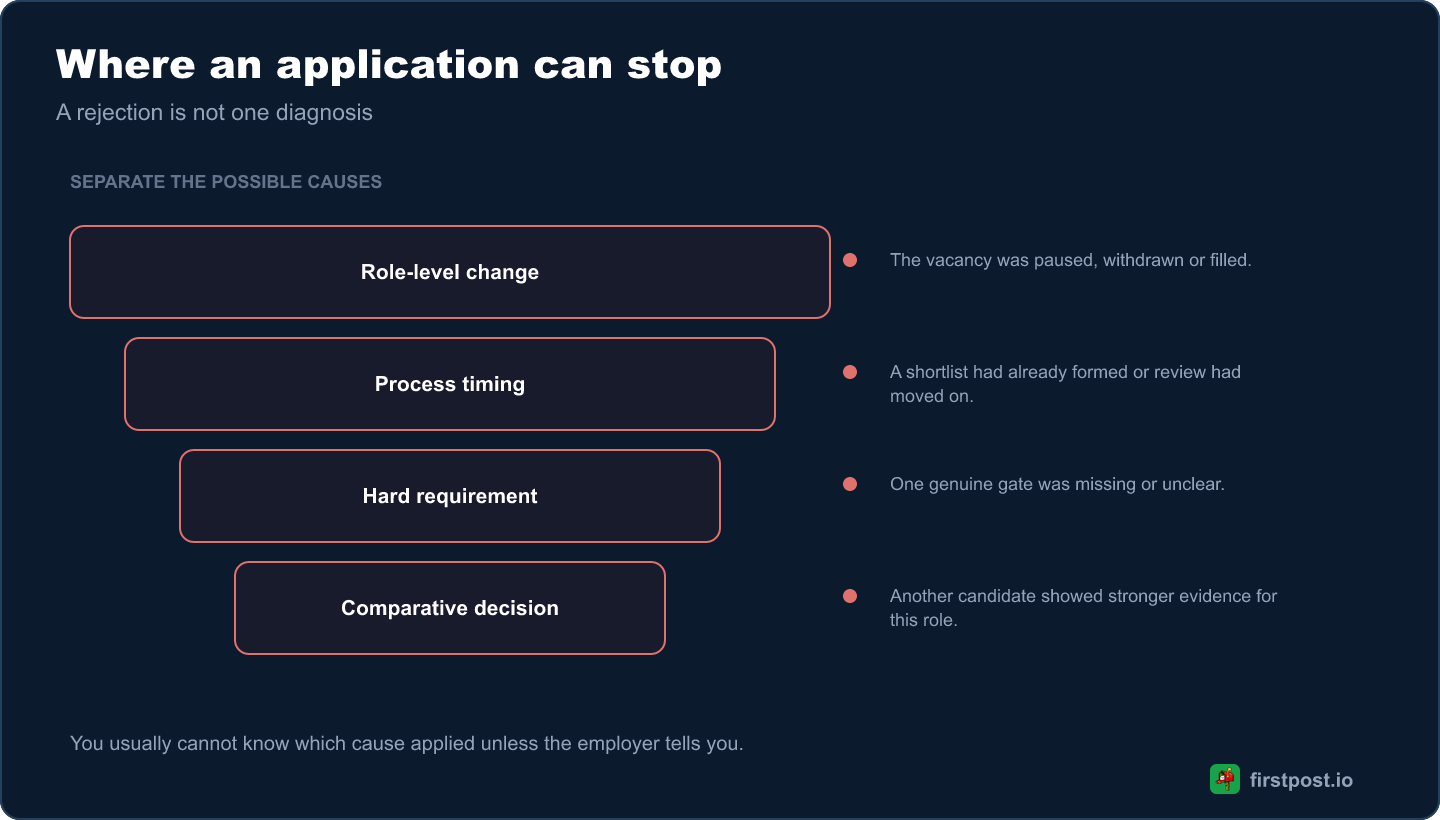
Walk down that funnel and notice how much of it is structural:
- The vacancy had changed. A copied advert may remain visible after the employer fills, pauses or withdraws the role. Check the source before assuming the application route was still active.
- An internal candidate may have had an advantage. Some employers consider internal applicants alongside external ones or under a separate policy. From outside, you usually cannot know whether that decided the result.
- The budget froze. Between the advert going up and you applying, the headcount got paused, reallocated or quietly cancelled. The role evaporated mid-process.
- You missed one hard must-have. A specific certification, a visa status, a language, a years-of-experience floor. Fair or not, a single missing essential can be an automatic filter.
- Review was already under way. Some employers progress candidates while the advert remains visible, so a later application can arrive after the comparison set has started to form. The review order is usually invisible from outside.
These possibilities mean an unanswered application is not clean evidence that your CV failed. That matters for morale, but it should not become an excuse to ignore patterns. Apply to suitable, current roles, then review the evidence you present when a sustained run produces no conversations.
The bits that genuinely are you (and are fixable)
None of this is a free pass. Some rejection is signal, and pretending otherwise helps no one. The real checklist:
- Targeting. If you're applying to roles a clear notch above your evidence - more senior, a domain you can't show you've worked in - the rejections are telling you something real. Aim where your CV can actually win, then stretch deliberately, not by default.
- Relevance, not polish. A recruiter skims for a fast yes on the role's top three requirements. If those aren't obvious in the first few lines, a strong CV reads as a maybe, and maybes lose to the early, obvious yeses. Tailor for legibility, not beauty.
- Volume as a substitute for fit. A large batch of generic applications can hide a targeting problem. A smaller set of well-matched applications gives you a clearer test. We discuss the trade-off in the job-search maths.
- Timing. Finding a suitable role at the employer source and applying before the queue builds gives you a real visibility advantage. It cannot control budgets or internal candidates, but it removes avoidable delay.
What to actually do with this
Do not treat each rejection as a verdict on your worth, but do not pretend to know the employer's hidden reason either. Concentrate on the parts you can inspect:
- Apply to fewer, better-matched roles, so a larger share are actually winnable.
- Make the match obvious in the first few lines, so the skim ends in a yes.
- Get to suitable roles before the queue and shortlist build, which is the point of applying early without rushing the application.
When it really is you
This is not a promise that the problem is never your targeting, CV or interviews. Ask someone credible to review the evidence when the pattern persists, and act on specific feedback. At the same time, get to suitable live roles before their queues build and stop reading every silence as a complete judgement. FirstPost surfaces matching listings from supported employer sources throughout the day, marks roles you have viewed and shows repost history when the same role returns; you still decide whether the vacancy and your evidence fit. Try FirstPost free.