
Will AI read your CV? What happens to your application
Software may parse, search, summarise, rank or screen parts of an application, depending on the employer and tools it has enabled. There is no single AI hiring pipeline, so prepare for the functions you can observe rather than one imaginary robot gatekeeper.
For a decade, the standard job-search anxiety was "the ATS will reject my CV for missing a keyword." It launched a whole cottage industry of advice about stuffing your CV with exact-match phrases and white-text tricks. Most of that advice was overblown then, and it's the wrong thing to worry about now.
What has changed is the range of optional tools employers can add around an applicant-tracking system. Some parse a CV into fields, some support search or ranking, and some run asynchronous assessments or interviews. Which of these appears in your application depends on the employer's configuration and process.
What sits between you and a human now
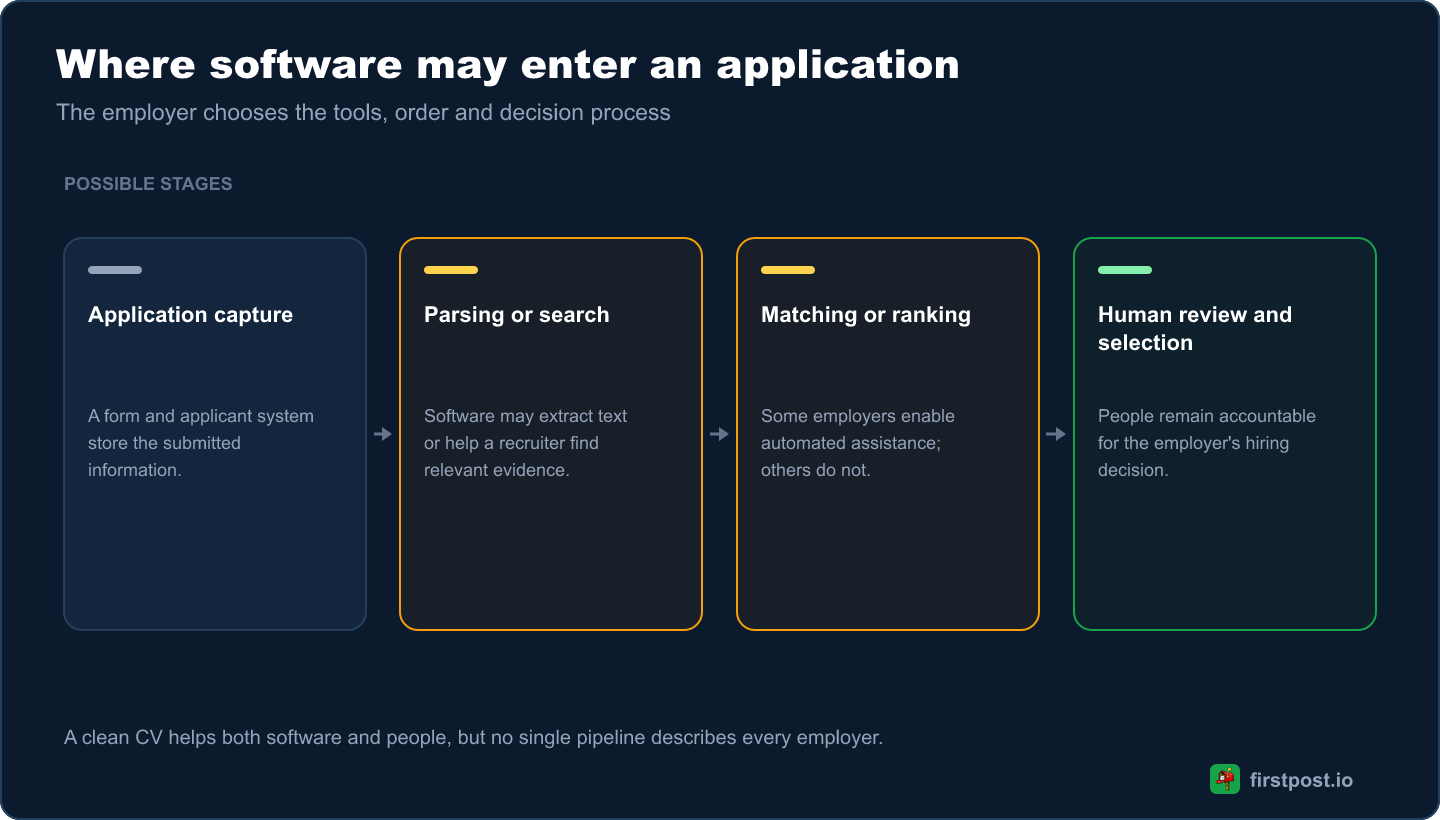
Walk the pipeline stage by stage, because the differences matter.
- The system may parse your CV. It can extract details into structured fields. Complex layouts, graphics or text stored as an image may be harder to parse, so our ATS explainer recommends a clear, conventional file.
- Search, matching or ranking may be enabled. These tools can help a recruiter navigate applications, but vendors and employers configure them differently. Do not assume a score is present or that it alone rejects you.
- A recruiter may review the original or parsed version. Write for a person who needs to find relevant evidence quickly, without inventing a universal skim time.
- An asynchronous assessment may appear. You might record answers, complete a structured task or interact with an automated tool. Read the employer's notice to understand what is being assessed and how your data is used.
- People remain part of the hiring decision. Exactly where they intervene varies, and regulated or automated decisions may carry additional notice and review rights depending on location.
How to handle each layer (without gaming it)
You do not need a separate personality for software and people. Clear structure and specific, truthful evidence make the CV easier to parse and easier for a recruiter to understand. That does not mean every model and recruiter score relevance in the same way.
- For the parser: use a clean, single-column, standard layout. Real headings, normal fonts, no text baked into images, file as a Word doc or simple PDF unless told otherwise. Don't sabotage yourself with design.
- For the AI ranker: make your fit explicit in plain language. If the role wants "stakeholder management" and you've done it, use those words - because they're true, not as a trick. Describe outcomes with specifics. A model summarising your CV will surface a concrete, relevant story far more reliably than a vague one. Reading the advert well tells you which words actually matter.
- For the recruiter: front-load the role's top three requirements in the first few lines. The skim ends in a fast yes or a maybe, and you want the yes.
- For an AI interview: treat it like a real interview, not a form. Answer in clear, structured points (a quick situation-action-result beats rambling), look at the camera, keep answers concise. Practise once so the format doesn't throw you. Don't try to keyword-stuff your spoken answers - it reads as oddly as it sounds.
What you should not do is the old white-text, keyword-stuffing nonsense. Modern parsers and models see through it, recruiters find it off-putting, and a CV optimised for a robot that doesn't exist just reads worse to the human who does. We told one cautionary version of where keyword-gaming leads in the story of the ChatGPT transcript that beat a real CV.
The bigger shift this is part of
AI tools have lowered the effort required to draft application material, but that does not prove a universal rise in application volumes or one standard employer response. What you can observe is more automated assistance on both sides and a continuing need to show relevant evidence clearly.
Precise targeting and early timing still matter. When you find a suitable role at the employer source and apply before its queue builds, the application has a real visibility advantage. The useful distinction is suitable and early: automation does not turn a weak match into a strong one.
Where the machines still lose
This is a fast-moving, uneven picture. The tools you meet depend on the employer, role and location, and the employer should explain consequential automated processing where the law requires it. A clean, specific CV remains useful across those variations, and there is no reliable "beat the AI" format. FirstPost handles a different part of the problem: finding suitable roles at their source early enough for you to apply before the queue grows. That timing advantage still matters. Try FirstPost free.