
A day in the life of a job posting
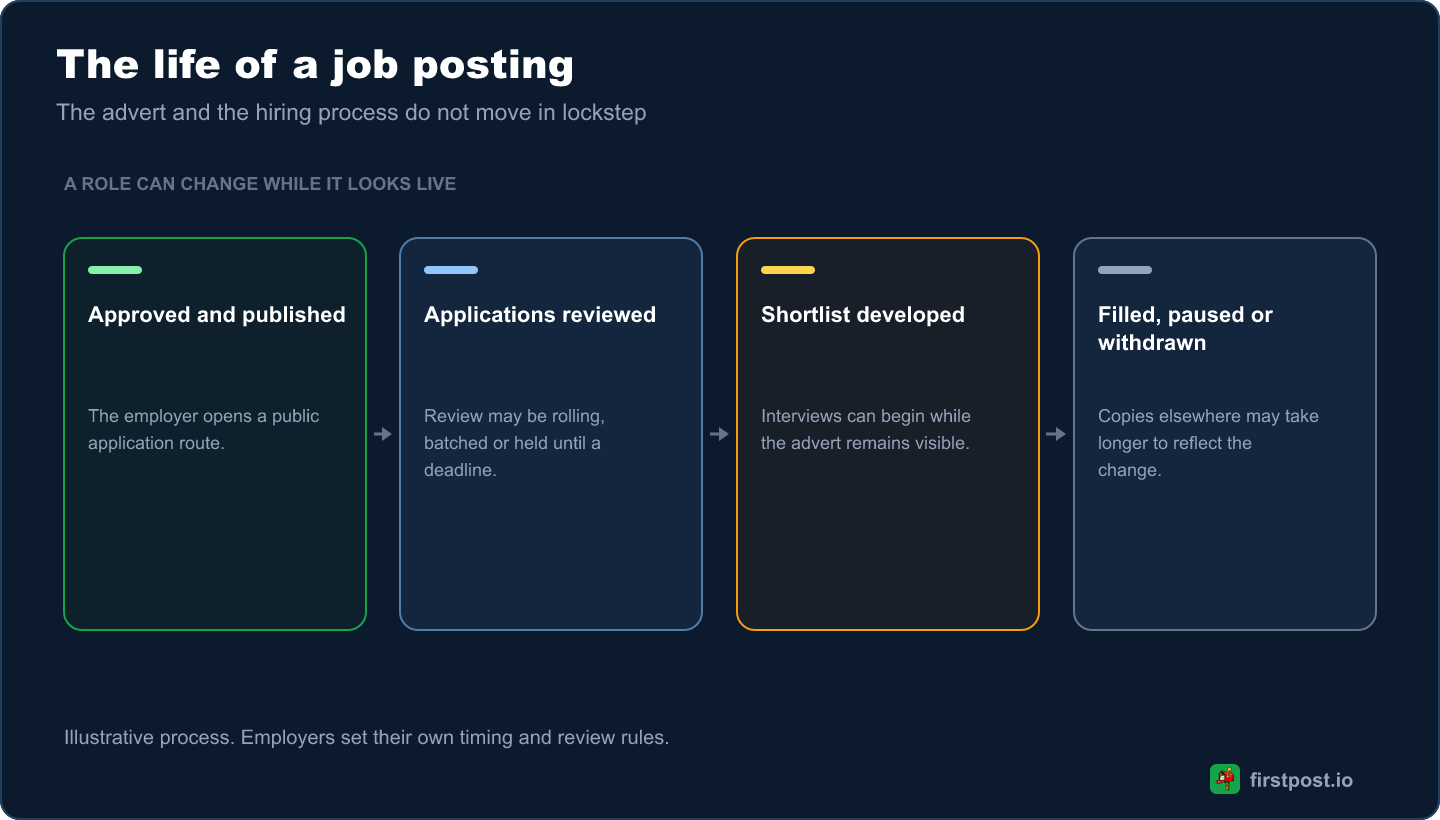
The easiest way to understand timing is to follow one fictional role from approval to shortlist. The exact hours will vary by employer, but the sequence shows where delays can enter and why an advert may remain visible after active review has slowed.
Let's follow one fictional role: a Marketing Manager position at a mid-sized company. The sequence below is an illustration, not a universal timetable. Some employers review as applications arrive, some work in batches and others wait until a closing date.
Monday, 9am: the role is born
It doesn't start with an advert. It starts with a budget. A marketing lead has been short-handed for two months, finally gets sign-off for the headcount, and the requisition is approved before anyone outside the company knows it exists. The lead already has a rough picture of who they want: someone who's done this at a similar-stage company, can start reasonably soon, won't need much hand-holding.
Monday, 11am: it goes live at the source
A couple of hours later, the advert is published on the company's own careers page - the canonical version, the original. At this exact moment, the role is as open as it will ever be. The shortlist is empty. The bar is "is this person good enough?", not "are they better than the people I'm already talking to?". Nobody is competing with you yet.
In our example, the advert is live at the employer before downstream boards or a weekly digest have surfaced it. Candidates watching the careers page directly can see it at this point, which gives a suitable application a real timing and visibility advantage before the wider queue builds.
Days 1 to 3: the flood
Word spreads. The advert gets cross-posted, an employee shares it and the company's followers see it. Applications start arriving and the recruiter begins reading. As credible candidates enter the process, later applications may be compared with a working shortlist rather than an empty one.
This is the useful mechanic behind applying early. Some recruiters review continuously and others work in batches, but reaching them before the queue and shortlist build gives a suitable application more room to be considered.
Day 4: the shortlist takes shape
In this scenario, the recruiter and hiring manager agree a first group worth speaking to and book screens. The role may remain open, but new applications are now being considered alongside people already in conversation.
Days 5 to 7: the aggregators arrive
Now a downstream job board catches up. Its copy can look new even though the employer's original listing has been live longer and, in our example, interviews are already being arranged. The exact delay and review stage vary, but this is the avoidable disadvantage of relying on a downstream copy alone.
Days 10 to 14: the shortlist closes
Final-round interviews happen and an offer goes out. The advert may remain visible while the employer completes the process or waits for acceptance, so a visible listing does not prove that the shortlist is still open.
The whole point, in one line
In this fictional example, review began while the advert was still visible. The candidate who found it at the source entered before the comparison set had grown, although timing could never compensate for a poor fit.
You can't slow the posting down, but you can meet it earlier by watching the employer's source rather than waiting for a downstream copy. Our guide to applying early covers the routine. FirstPost watches source listings, emails matching roles in a daily digest and uses its Hiring Spike marker to flag unusual increases in an employer's posting volume. That does not prove funding or faster decisions; it tells you where hiring activity has changed so you can inspect the roles promptly. Free to start.